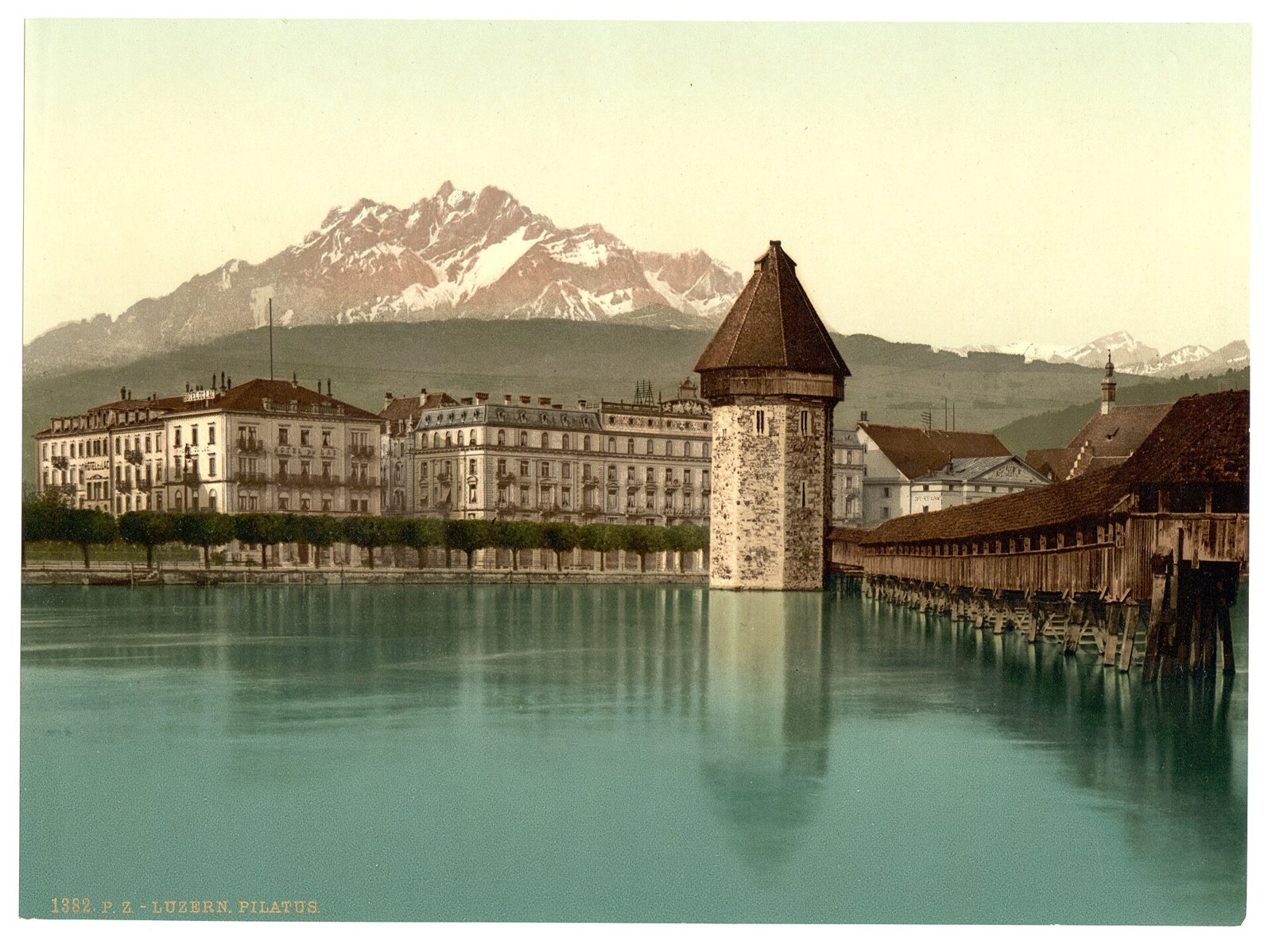
The flower bridge
The Kapellbrucke is the thing everyone photographs and it deserves it. A covered wooden footbridge running at an angle across the Reuss, roughly 200 metres of it, with flower boxes along the sides for most of the year.
We were lucky enough to be staying where we could look out over it every morning, which is a different relationship with a landmark than walking up to it once. It changes through the day. Early, with the light low and nobody on it, is when it is worth getting up for.
It was built around 1333, as part of the city walls rather than as something to admire, and it is one of the oldest covered bridges in Europe. Up in the gables there are painted panels of the city’s history, put there in the seventeenth century. Most of the bridge burned in a fire in 1993 and a great many of those paintings went with it. What you walk across now is a careful restoration, and the gaps where panels were lost have been left rather than faked.
Partway along, the bridge bends around the Wasserturm, the octagonal stone water tower. The tower is older than the bridge and has been, at various points, a prison, a treasury, an archive and a watchtower.
Give the lake a day
The boat ride is the best thing we did in Lucerne, and it is easy to treat it as transport and miss that.
Lake Lucerne is long and bent, with arms running off between steep green mountains, so the view keeps changing rather than opening once and staying put. Boats run all year and a few of them are old paddle steamers. You can get on for a short hop or stay on for hours, and the slow version is the point.
Tip
Treat the boat as the day rather than the way to the day. Get on without a firm plan about where to get off. It is one of the few places where the journey genuinely is better than arriving somewhere.
Up to the Burgenstock
High above the lake there is a ridge called the Burgenstock, and on it the Burgenstock Resort and its Alpine Spa.
Getting there is half of it. You cross the water by boat and then go up on a funicular that has been running since 1888 and has been restored to look it, climbing a few hundred metres up the side of the ridge. By the time you are at the top you have already had the best of the view.
The spa is the famous part, and the infinity pool wrapping the corner of the building is the reason people come. You swim up to an edge and the lake is a long way below it. It is expensive and it is unapologetic about that.
Tip
The funicular and the boat across are worth doing even if the spa is not in your budget. The ride up and the view from the top are the parts that stay with you.
Lucerne puts you on Italy’s doorstep
This is the thing worth knowing when you plan: Lucerne to Milan is about three hours on a direct train, and from Milan you can reach most of Italy.
The route runs south through the Gotthard Base Tunnel, which at the moment is the longest railway tunnel in the world. You are inside it for about a quarter of an hour. You go in with Switzerland on one side and come out into Italian-speaking Ticino, and the change in the landscape is abrupt enough to be funny.
If you have ever looked at a map and tried to decide between Switzerland and Italy, this is the answer. You do not have to choose.