Travelling with celiac disease or gluten intolerance means doing homework that other people never think about. It is entirely doable. It just moves some of the work to before you leave.
Here is what actually helps. City by city restaurant guides are coming too, and you can follow those here.
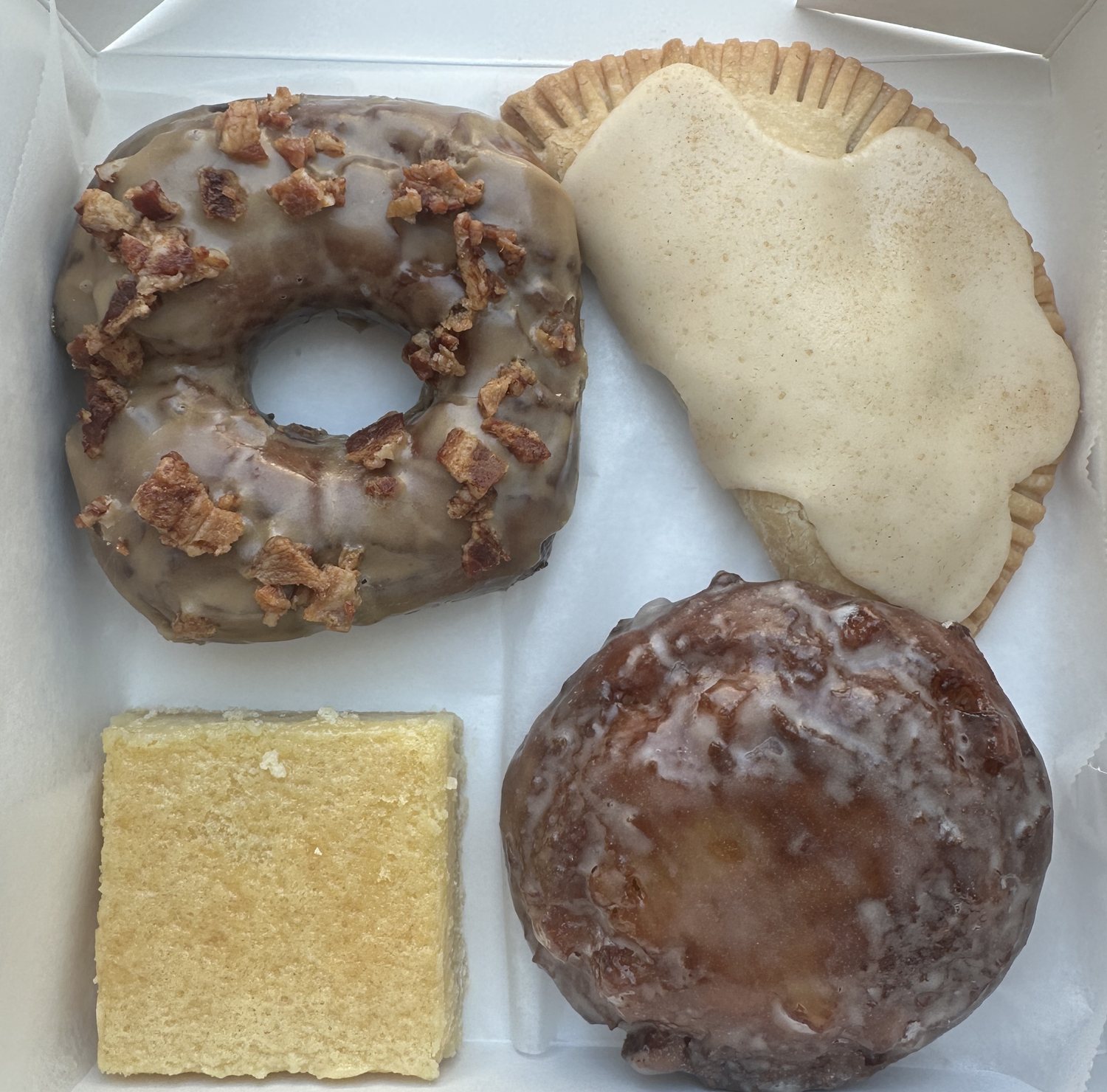
The box above is from Blue Moon Bakery in Hillsboro, Oregon, where everything in the case is gluten free. Places like that exist in more towns than you would think, and finding them is most of the work.
Research before you go, not when you are hungry
Standing on a street at eight in the evening deciding where to eat is the worst moment to start looking. Do it at home instead.
Find Me Gluten Free and Gluten Free Globetrotter are both worth an hour before a trip. Save a handful of places near where you are staying, not just near the sights, because the day you most need a safe meal is the day you are tired and do not want to travel for it.
If you are booking a hotel, email and ask before you arrive. The answer tells you something either way. A kitchen that has thought about it will say so clearly.
Pack more than you think you need
Assume at least one day where you find nothing. Nuts, seeds, fruit, hard boiled eggs and gluten free bars all travel well and cover the gap.
What is worth carrying depends entirely on whether you have a car boot or a cabin bag, and most packing lists ignore that.
On a road trip
A car changes the maths. Weight and bulk stop mattering, so take the things that solve a problem properly rather than the compact version that half solves it.
-
An air fryer. This is the one we would not travel without, and it took us a while to work out that it beats the obvious answer. A travel toaster solves breakfast, and breakfast is a real problem: a shared hotel toaster is the single most contaminated object at a buffet, so having your own means you can eat the bread you brought without thinking about it. But an air fryer does that and cooks dinner. Frozen food from a supermarket, vegetables, chicken, reheating what you did not finish at lunch. On a long trip that is the difference between finding somewhere safe to eat every single night and only needing to when you feel like it.
The real point is that it is your equipment. No shared fryer, no shared grill, no tongs that were in the bread. The whole cross contamination problem disappears for any meal you decide to cook yourself.
Two things to check. Ask the hotel, because plenty of them forbid cooking appliances in rooms, and aparthotels and extended stay places are the easy yes. And this only works at home voltage: an air fryer draws well over a thousand watts, far more than any travel converter handles, so a plug adapter will not make an American one work in Europe. For a road trip abroad, book places with a kitchen instead.
-
A cool bag. Cheese, leftovers, and anything you found in a good supermarket and will not find again for three days.
-
A kettle and a couple of bowls. Instant oats, rice, soup. Between a kettle and an air fryer, any hotel room becomes somewhere you can eat at nine at night when nothing is open.
-
A knife and a small board. For fruit and for bread that is safe until someone else’s crumbs reach it.
-
A proper stock of staples. Buy in the first big supermarket you pass, not the last one before you need it.
Flying
Everything above is wrong on a plane. Take the things that weigh nothing and solve the same problems.
- Toaster bags. Reusable silicone or PTFE sleeves that weigh almost nothing and let you use a shared toaster without your bread ever touching it. This is the flying answer to the problem the air fryer solves in a car, and it fits in a pocket.
- Sachets rather than bottles. Tamari, oil and nut butter all count as liquids or gels at security, so hand luggage means 100ml containers or single serving sachets.
- Snacks for the travel day itself, when airports and stations are at their worst and everything behind the gate is a sandwich.
- Anything you rely on that is hard to find abroad. Gluten free staples are everywhere in some countries and nearly absent in others.
Warning
Check the rules before you pack food. Australia, New Zealand and the United States all take biosecurity seriously, and fresh food, seeds, meat and dairy can be seized or fined. Sealed packaged food is usually fine. Declare it anyway. Declaring costs you a minute and not declaring can cost a great deal more.
Learn to say it in the local language
Learn the phrase before you go. Every time. It takes five minutes and it is the difference between being understood and being agreed with.
Being clear beats being polite. Explain that you need to avoid gluten completely, not that you would prefer to.
| Where | Gluten free |
|---|---|
| Portugal, Brazil | sem gluten |
| Spain, Latin America | sin gluten |
| France | sans gluten |
| Italy | senza glutine |
| Germany, Austria | glutenfrei |
| Netherlands | glutenvrij |
| Poland | bez glutenu |
| Czech Republic | bez lepku |
| Greece | horis glouteni |
| Japan | guruten furi |
| China | wu fu zhi |
Two places where the phrase alone is not enough. In Japan, gluten is not a widely understood idea, but wheat is: the word you want is komugi, and saying you cannot eat wheat gets much further than saying gluten. Soy sauce is brewed with wheat, so it is in almost everything. In China, the same is true of soy sauce, and asking about xiaomai, wheat, works better than asking about gluten.
Tip
A printed card in the local language does this better than you can, especially where you do not share a language with the kitchen. Hand it over rather than explaining. It travels from server to chef intact, which your spoken explanation often does not, and it does not get softened on the way.
Cross contamination is the part people miss
Getting a gluten free dish is only half of it. Gluten arrives through shared fryers, shared pasta water, shared toasters, shared grills and the same tongs used for everything.
Worth asking directly whether your food can be cooked in a clean pan. A kitchen that takes the question seriously is one you can eat in. A kitchen that waves it away has told you what you need to know.
When in doubt, skip it
This is the whole thing in four words. If the answer you get is vague, if the kitchen seems unsure, if nobody quite understood the question: do not eat it. Find somewhere else.
Some days the interesting restaurant is not going to work, and a salad and a supermarket run is the right answer. That is not a failure of the trip. Eating something safe and dull beats losing two days of a holiday to being ill.
What we carry for when it goes wrong
Because sometimes it does, and being three thousand miles from home makes it worse.
Digestive enzymes. Some people carry gluten enzyme supplements for accidental exposure. What they may do is take a little off an accident that has already happened.
Warning
Enzymes do not make gluten safe. They are not a treatment for celiac disease, no doctor will tell you they protect you, and they are not permission to eat something you are unsure about.
Peppermint. Tea, or oil in capsules. It settles cramping and bloating and it is the thing we reach for first. Worth knowing it can make reflux worse, so if that is your problem, ginger instead.
Electrolytes. A day of being ill in a hot country dehydrates you faster than you expect, and sachets weigh nothing.
None of this replaces avoiding gluten. It is what makes a bad day shorter.
This is general guidance rather than medical advice. If you have celiac disease, your own doctor knows your situation better than any travel blog does.