Sardinian first, Italian second
People here will tell you they are Sardinian before they are Italian. Plenty of places in Europe say something like that. This one has the paperwork.
Start with the language. Sardu is not a dialect of Italian. It is its own Romance language, descended from Latin separately, the way French and Spanish were, and linguists generally call it the most conservative of the lot: it has held on to things the others let go of a thousand years ago. Italy recognised it formally in 1999 and UNESCO lists it as a language in its own right. You are not listening to accented Italian. You are listening to a different language.
Then the towers. From around 1800 BC the people here built nuraghi, cones of dry stone that worked as strongholds and houses and meeting places, and roughly 6,500 of them are still standing. There is nothing quite like them anywhere else. You pass them in ordinary fields with no sign and no fence, because when you have six and a half thousand of something you stop making a fuss over each one.
Then the part that explains the attitude. In the early middle ages, as Byzantine power drained away and raiders kept arriving at the coast, the island fell out of everybody’s empire. Instead of collapsing it organised itself into four independent kingdoms, the Giudicati, and governed itself for several hundred years while most of Europe was busy being feudal. One of them, Arborea, produced Eleanor, who in 1392 issued a legal code called the Carta de Logu. It was written in Sardinian, it covered property and inheritance and crime, and it remained the law of the island until 1827. Four and a half centuries.
Phoenicians, Carthaginians, Romans, Pisans, Genoese, Aragonese, Spanish and Savoyards have all had a turn here, and Italy is only the most recent of them. Hold that in your head and the rest of the island makes sense: why the old towns sit up on hills with their backs to the sea, why the food is mountain food, and why nobody here is especially interested in being a region of anywhere.
Getting there, and which end to land on
You can fly in direct from London, which surprises people. Flights go to both Cagliari in the south and Olbia in the northeast, so the first real decision is which end of the island you want to be standing on.
We flew into Cagliari and in hindsight we should have flown into Olbia. We spent the trip in the northwest and on the east coast, so the arrival put us at the wrong end and we drove north past a lot of island we never stopped in. Cagliari is the right choice if you are giving the southern coast proper time. We were not, so it mostly cost us a day.
Cagliari itself we would not linger in again. The exception was the gluten free pizza, which was spectacular and among the best things we ate anywhere on the trip.
Tip
Pick the airport that matches your itinerary rather than the cheapest fare. Olbia for the north, the east coast and the Gulf of Orosei. Cagliari only if the south is genuinely part of the plan. The island is bigger than it looks and the roads wind, so landing at the wrong end is a real cost in driving, not a small one.
Watch out
Getting between the airport and town costs more here than you will be expecting, and the usual instinct is the wrong one. Take the taxi, not the ride app. In both Cagliari and Olbia the taxi worked out cheaper for us, which surprised us until we understood why: Uber in Italy is mostly the licensed private hire version rather than the cheap one, so it is competing at the top of the market rather than the bottom. Ask what the fare to the centre will be before you get in, and agree it.
The distances are longer than the map suggests, so the island rewards picking a stretch of coast and staying with it. We went northwest for the towns and the swimming, east for the water, and left by sea.
Tip
If any of the history above landed, build in one stop at a nuraghe. There are thousands, most of them unattended and free to walk up to, and standing next to a dry stone tower somebody stacked three and a half thousand years ago does more for your sense of the place than another beach will.
Rent a car, and read this first
You need a car here. Public transport will not get you to the places worth going, and that is simply the shape of the island.
Two things we got wrong, one of them expensively.
Warning
If your licence is not from the EU, bring an International Driving Permit. Italy requires one alongside your own licence, and rental desks enforce it. We did not have one, we were turned away, and we lost the money on our first booking. In the United States only AAA and AATA issue the real thing, it costs about twenty dollars, and you can walk out of a AAA branch with it the same day. Anything sold on Amazon or eBay is fake and will be refused. Without one you can also be fined if you are pulled over.
Tip
Book the smallest car you can live with. Sardinian village streets and the roads up to the hill towns were not built for anything wide, and the parking is worse. Nobody has ever regretted a small car here.
Pelosa, and how to actually get in
Pelosa was the busiest place we went on the whole island, and it was still our favorite swim anywhere on it.
The water is shallow a very long way out, far enough that you keep walking and it is still only at your knees. That shallowness is what does it. The sea comes out in bands of different colors, pale where the sand sits close under you and deepening as the bottom drops away, and you see all of them at once. There is a ruined watchtower on the small island off the beach, and having something old and square in the middle of all that water is what makes the view distinctive rather than simply pretty.
The sand here is fine enough that it leaves on people’s towels, which is why the beach is now managed rather than open.
Tip
From 15 May to 15 October you have to book Pelosa in advance. The cap is 1,500 people a day, access runs 8am to 6pm, and it costs 3.50 euros a head with under twelves free. One booking covers up to four people. If it looks sold out, check again two days before: around a thousand more places are released then, at 9am.
Watch out
Bring a mat. You are required to put something between your towel and the sand, because the sand leaving on towels is the whole reason for the limit. A towel straight onto the beach is what gets you spoken to.
Go early in the day. We would go back knowing it is the busiest beach on the island.
Bosa
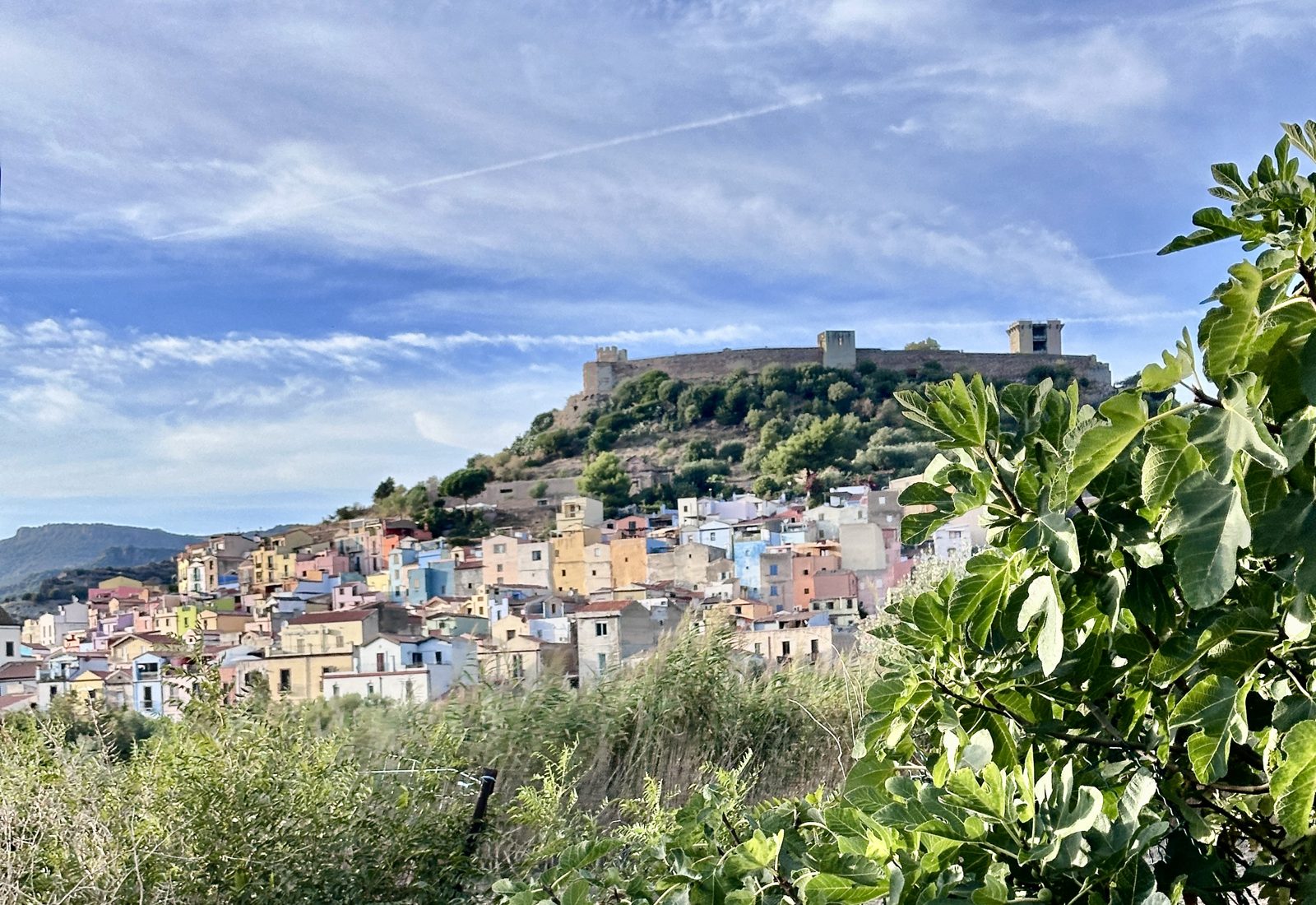
Bosa sits a little inland on the Temo, which is the only navigable river in Sardinia, and the old town climbs the hill on the far bank in a run of pink, yellow, blue and orange houses that look deliberate rather than accidental.
The medieval quarter is called Sa Costa and it is the reason to come: narrow lanes, steep stairways and small squares stacked up the hillside under the castle. Castello Malaspina is at the top, and the climb is worth it for the view back down over the painted houses and the river bending away.
It is also Malvasia country. The sweet wine made here does not travel much beyond the island.
Bosa is an easy place to walk, so you do not need the little tourist train that runs between the centre and Bosa Marina. On a hot day you will want it anyway. It is cheap, you buy a ticket at the stop in town rather than booking anything in advance, and we took it and were glad. Do not confuse it with the Trenino Verde, which is the heritage railway down from Macomer, a two hour scenic trip and a different order of money.
Tip
The one we did not get to, and the reason we have to go back, is Cane Malu. It is a natural pool carved by the sea into white rock on the point just north of Bosa Marina, about ten minutes on a signposted path from the mouth of the Temo, and it costs nothing. The rock around it is pale and cratered enough to look lunar, with very blue water sitting in the middle. Take something on your feet, because the rock is sharp and slippery, and only go in when the sea is calm.
Those two things pair neatly: take the train down to the Marina, then walk out to the pool from there.
Castelsardo
Castelsardo is up on the north coast, walled and stacked on a headland so you see the whole town from the road long before you reach it. The Genoese Doria family founded it in the twelfth century as a stronghold over the Gulf of Asinara, and from the ramparts you can see the gulf, the town below you, and Corsica on a clear day.
The castle holds the Museum of Mediterranean Weaving, which sounds like a dutiful stop and is not. Castelsardo baskets are woven from dwarf palm and asphodel, they were working objects for fishing and daily life, and the craft is still alive in the town rather than preserved for visitors. Walk the old town and you will pass women weaving in the doorways of small shops.
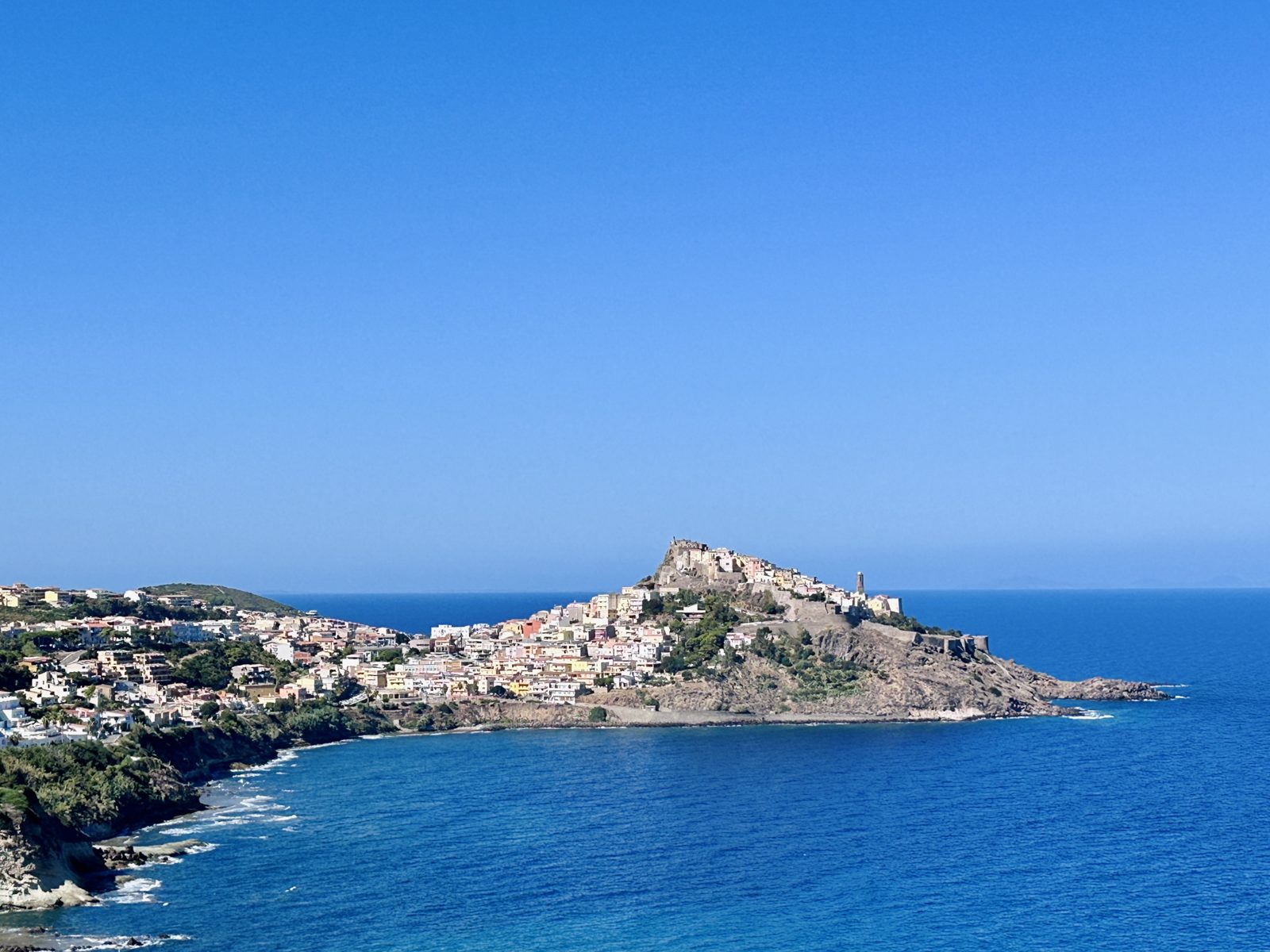
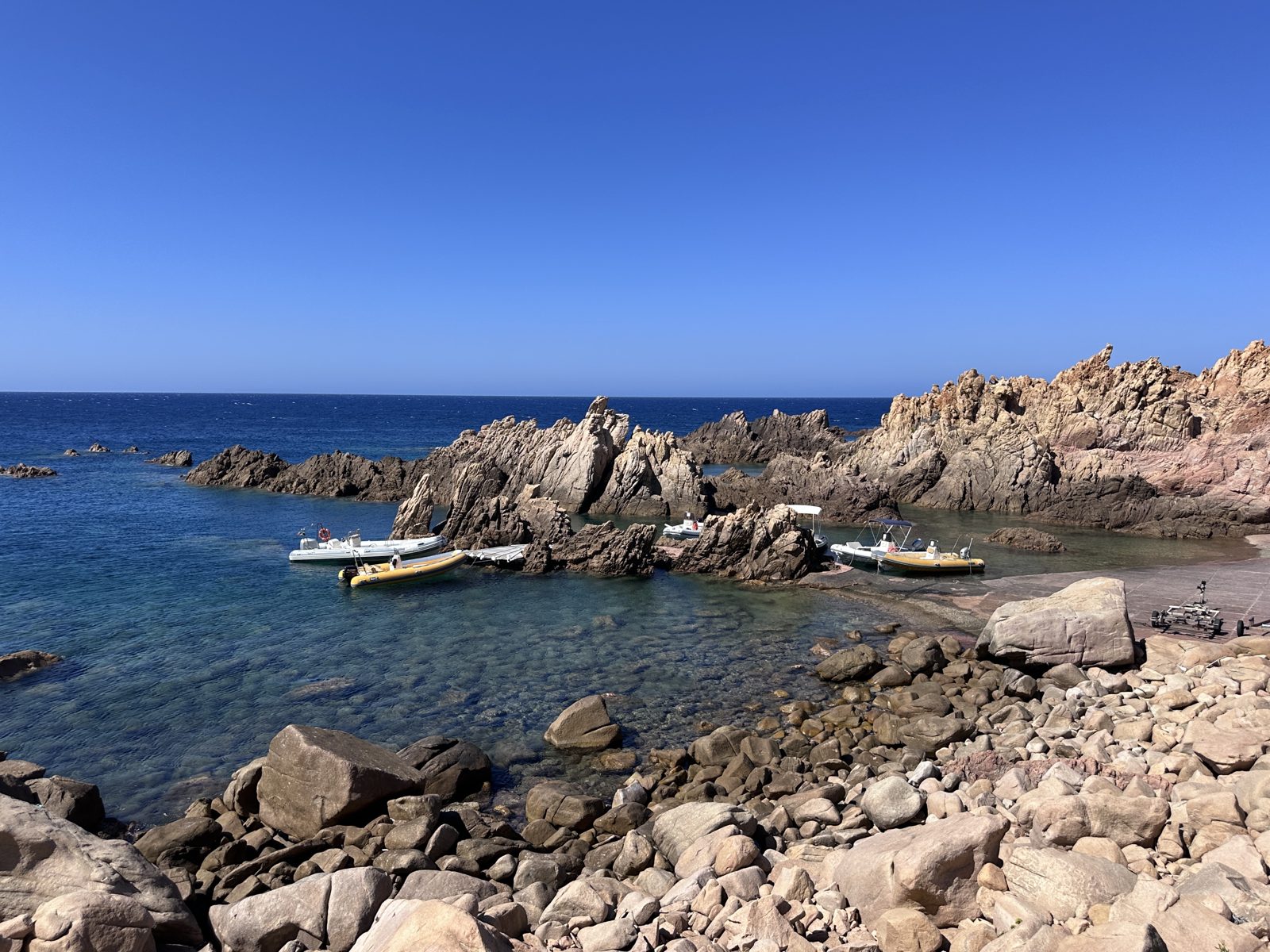
The north coast around here is worth slowing down for in its own right. The rock turns pink and red and breaks into jagged stacks, and between them are shallow coves with water clear enough to see every stone on the bottom, most of them reachable only by small boat.
The east coast, by boat
The east is where we did our swimming, and the thing worth knowing is that the water over there is warmer and calmer than on the exposed western side.
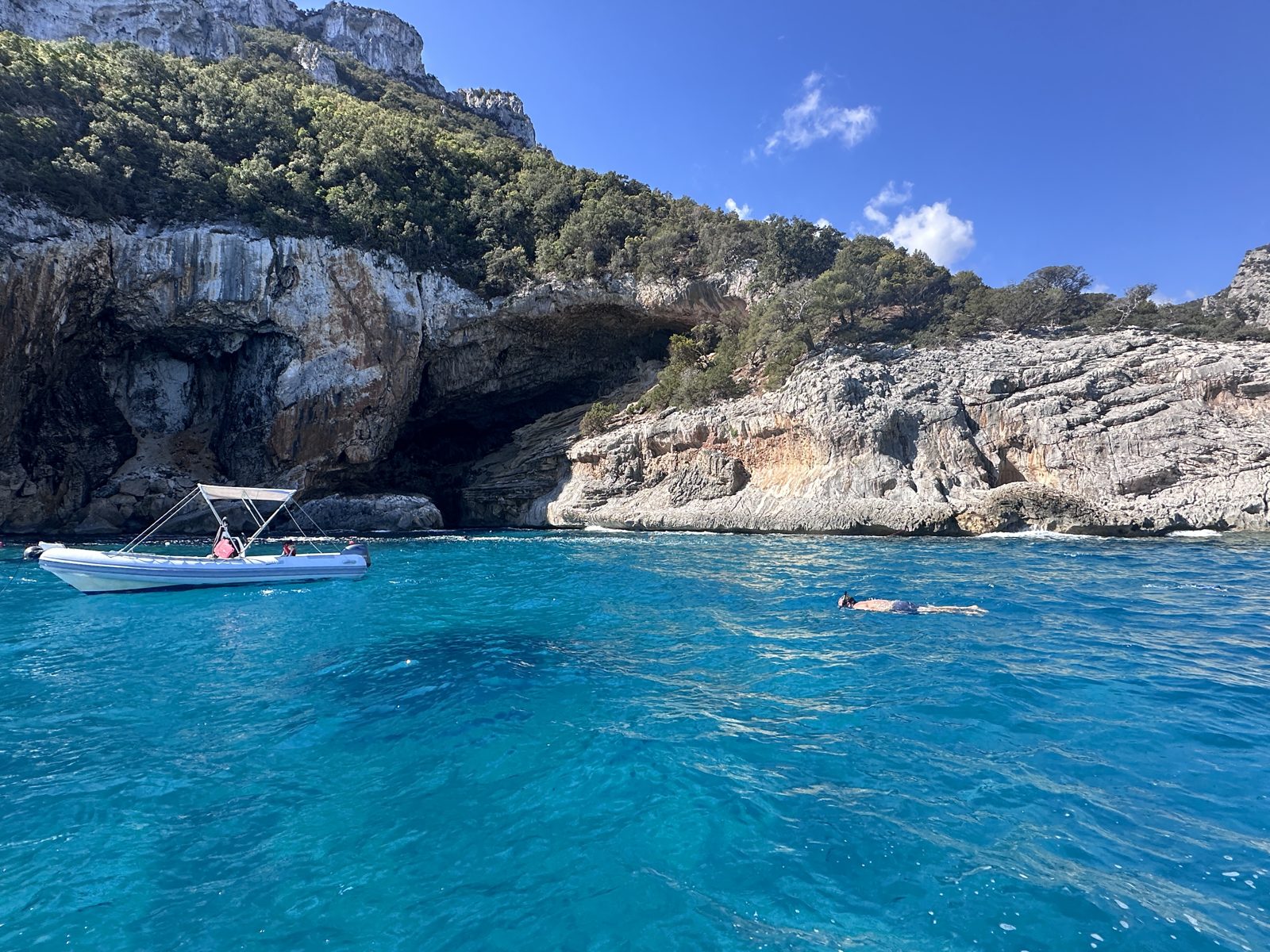
We took a boat out of Cala Gonone into the Gulf of Orosei, which turned out to be the right way to see that coast. Most of what is worth stopping for sits under cliffs with no road to it, so the water is not just the nicer way in, it is frequently the only way. A full day runs along Cala Luna, Cala Mariolu, Cala Sisine and Cala Biriola, usually with a look at the Grotte del Bue Marino, and at Cala Goloritze you swim off the boat rather than landing, because that one is a protected site reached on foot or not at all.
Getting into calm warm sea off the back of a boat, in a cove with nobody else in it, is a different thing from walking onto a beach.
Tip
If you only have one swimming day, spend it on the east coast. Warmer and calmer stops being an abstract difference the moment you are in the water.
About the food
We will be honest: the food did not move us the way mainland Italy does, and it is a lot more meat than you might be picturing for an island.
There is a reason for that, and knowing it made us read the menus differently. For centuries Sardinians kept away from their own coast, because the coast is where the raiders landed and where the malaria was. Life moved inland and uphill, and what grew there was a shepherd’s culture: roasted meat, bread, and a great deal of cheese. The seafood tradition is real but it is the newer, thinner layer. The old food of Sardinia is mountain food that happens to be surrounded by sea.
So the island is not the place to arrive expecting the pasta and tomatoes version of Italy. Come for the water and the towns, eat the meat and the cheese, and keep your pizza expectations for Cagliari.
Leaving by ferry, not by plane
Eat properly before you board. The crossing is the better part of a day and the food on board is ferry food, so a real meal in Olbia first is worth building into the plan rather than treating as a nice extra. We did, and it turned a long sailing into a comfortable one.
We left Sardinia by sea. Olbia to Civitavecchia is the most frequent route to the mainland, it runs daily, and it takes somewhere around six to eight hours depending on the sailing.
There are two shapes of crossing and the choice matters more than it looks. There is an overnight sailing, which gets you a night’s sleep instead of a hotel and puts you in Civitavecchia in the morning with a whole day in front of you. And there is an afternoon one, which is the one we took, leaving after lunch and docking late in the evening.
The afternoon crossing is the better day at sea. You are on deck in daylight, watching Sardinia go, rather than asleep in a cabin. The cost is what happens at the other end.
Civitavecchia is the port for Rome rather than Rome itself, and getting from one to the other is straightforward as long as you know it is not a single step. A free shuttle takes you off the ferry and out of the port. From where it drops you, the train station is several blocks away through the town, on foot, with whatever you are carrying.
That walk is pleasant and there are restaurants along it, so if you have time between the boat and the train it is a good place to eat rather than a corridor to hurry down. Just leave yourself enough: you still have to buy a ticket and find the right platform at the other end of it.
Tip
Civitavecchia station has two entrances, and only one of them is step free. If you have a suitcase, keep walking to the second entrance, the one with the ticket office, and you can get in without stairs. There are also lifts for getting bags to the platforms. Worth knowing before you haul everything up the first set of steps you see.
Watch out
If you take the afternoon sailing you will dock late in the evening, and everything above happens in the dark: the shuttle, the walk through town, the hunt for the ticket office. Check the last train to Rome before you book the boat, not after, because the one you want may not be there. If the timings are tight, either take the overnight crossing instead or plan to sleep in Civitavecchia and go into Rome in the morning.
Arriving in Italy by ship, having started the trip on an island that does not feel like Italy, is a better ending than an airport.