Rome does not let you rest. The ground is hard, the queues are long, and the city has been accumulating things to look at for about 2,800 years, so there is never a moment where you have finished. Three or four days in and most people need a day that is not that.
The good news is that you do not need a car, or a tour, or a very early alarm. Two of the best days out from Rome are on ordinary trains for the price of a coffee, and they are completely different from each other. Pick by weather and by mood.
Bracciano, for a hot day
Bracciano is a town on a lake about an hour northwest of Rome, with a castle on top of it.
Getting there: take the FL3 regional line from Valle Aurelia or Ostiense. It runs through the day, takes around an hour, and costs about three or four euros each way. Buy at the machine, and keep the ticket until you are out the other end.
Watch out
The train and the town are up on the hill. The lake is down at the bottom of it. Nobody tells you this and it is the one genuinely tiring part of the day: the walk down from the station and the town to the water is long, and the walk back up is the same hill in reverse, in the afternoon heat, after you have been swimming. Wear shoes you can walk in rather than flip flops, take water with you, and if there is a bus or a taxi going back up at the end of the day, take it and do not feel bad about it.
Swim first. The lake is the reason to come and we would do it in that order again. Lake Bracciano is volcanic, which is why it is almost perfectly round, and it is one of the cleanest lakes in Italy for a reason that is not luck: motorboats are banned on it and it supplies drinking water to Rome, so the protection is real and so is the clarity. It was an amazing swim, and after three days of Roman pavement it was the best thing we did all week.
There are beaches at Bracciano itself and at Anguillara Sabazia and Trevignano Romano, two more small towns on the same shore and the same train line. If you have a full day you can swim at one and eat at another.
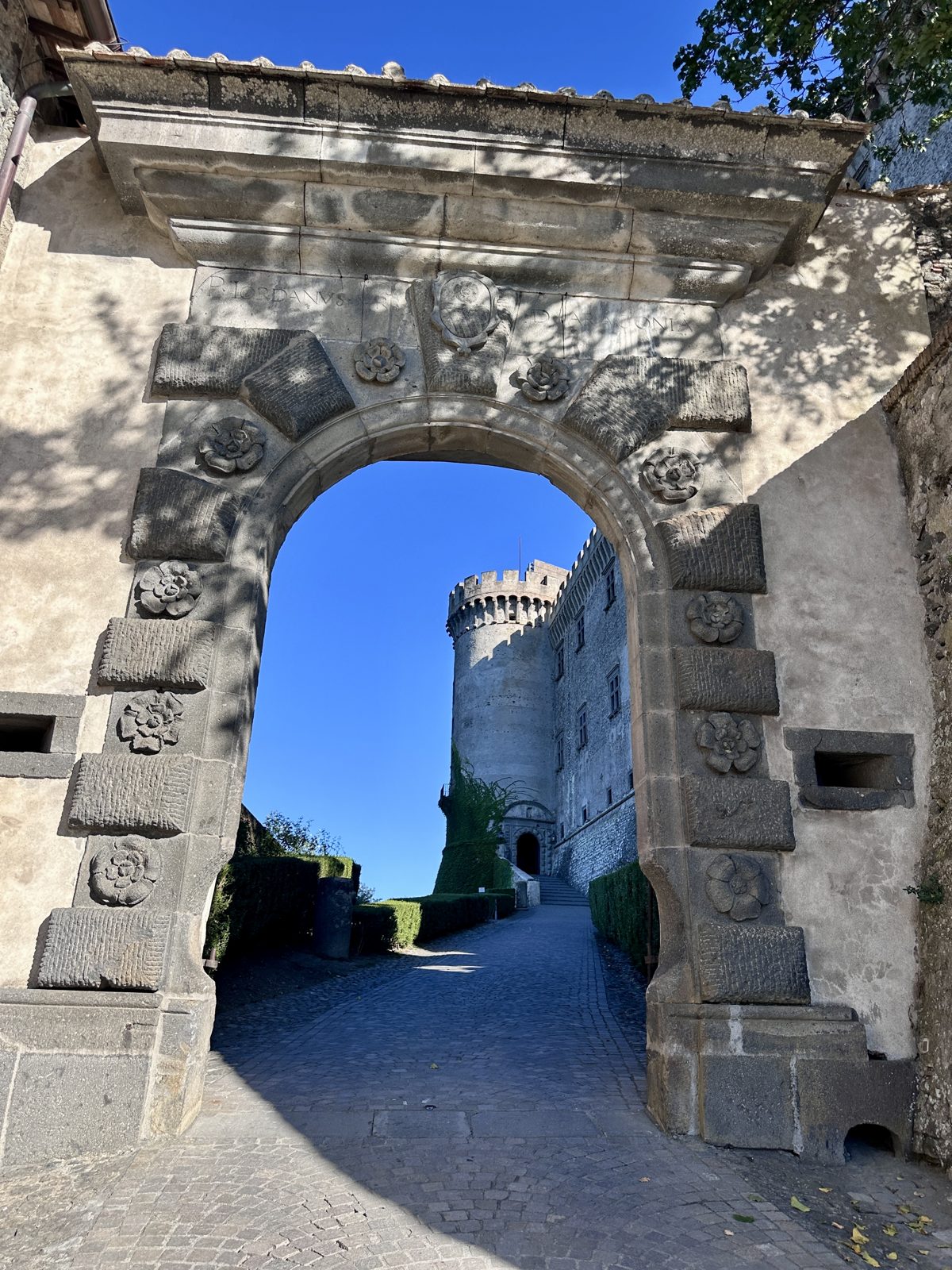
Then the castle. Castello Orsini-Odescalchi is fifteenth century and was lived in rather than only defended, so it is a more interesting walk around than the usual empty stone shell. It belonged to two of the most powerful families in the region and parts of it still feel domestic. It sits above the town with the lake underneath, so the views come with the ticket. Doing it after swimming, dried off and in no hurry, is the right way round.
Then the gelato. We had the best gelato of our lives in Bracciano. Not the best in Italy, not the best that week, the best we have ever had. We have thought about it since.
It is called Picchio Gelateria Naturale, on Via della Collegiata, just downhill off the square from the castle, so you will walk past it anyway. It is not a secret, for the record: it holds Two Cones in the Gambero Rosso gelato guide, which is the Italian rating that actually means something. They work from fresh bases rather than a freezer, change with the seasons, and buy direct from producers, which is why it tastes like the fruit rather than like the idea of the fruit. There are vegan flavours too, including two chocolates and a pistachio, so it is a stop that works if your table is avoiding dairy.
Tip
This is the better of the two trips in hot weather, and the one to pick if anyone in your group has run out of patience for ruins. It is also the cheaper day by a wide margin. Bring something to swim in, because you will regret watching other people get in the water.
Honestly, we wanted longer. Bracciano is completely doable in a day if you get an early start, and we did it, and it was one of the best days of the trip. But we spent it moving: down the hill, into the water, back up the hill, around the castle, and then watching the clock for the train. One night there would have been better. A lake day and a town day, with an evening in between and no train to catch, instead of trying to be a swimmer and a tourist between two timetables.
If you have the night to spare, spend it. If you do not, start early and take the lake first.
Tivoli, for the gardens
Tivoli is east of Rome, up in the hills, and it is where wealthy Romans went to get out of the heat. They have been doing it for two thousand years.
Tivoli has three famous sites, and the single most useful thing we can tell you is that two of them are within walking distance of the train and the third is not. Do the two. Leave the third for a trip of its own.
Getting there: train from Tiburtina to Tivoli, then up into the town. The station sits below the old centre, so there is a climb of about twenty-five minutes on foot, or a local bus if you would rather. Once you are up there, everything below is on foot.
Villa Gregoriana is the one nobody warns you about and the one we would send you to first. It is a garden in a river gorge, and at the bottom of it is the Grande Cascata, a waterfall of about 120 metres that is the second highest in Italy. You walk down through woodland and switchbacks and caves to reach it and then you walk back up, so treat it as a hike rather than a stroll.
It is also a garden built on top of a villa, which is why it feels older than it is. The park itself was laid out in 1835, after a flood wrecked the river, but inside it are the ruins of a Roman villa, and the temples of Vesta and the Sibyl stand on the rock above. It was neglected so badly in the twentieth century that part of it was used as a rubbish dump, and it only reopened in 2005 after a full restoration.
Villa d’Este is the grander, more finished one, and the famous one. A sixteenth century cardinal’s villa with a garden dropping down a steep hillside, where the garden is really a water engineering project wearing a disguise. Hundreds of fountains, every one fed by gravity from the river above, with no pumps involved anywhere. It is a UNESCO site and it earns it.
Hadrian’s Villa, or Villa Adriana, is the third, and it is the one that is not walkable. It is the enormous ruined country estate the emperor built for himself in the second century, closer to a small town than a house, and it is a few kilometres outside Tivoli. Reaching it means Metro line B to Ponte Mammolo and then a Cotral bus. It is worth seeing, but trying to bolt it on to the other two is what turns a good day into a day spent waiting at bus stops.
Tip
Do Villa Gregoriana first, while your legs are fresh, then Villa d’Este afterwards. One is a climb and the other is a wander, and that is the easier order to do them in.
Watch out
If you are counting on the local bus between the station and the town, build in slack. Buses in Italy run late and sometimes do not come at all. The walk up is about twenty-five minutes and uphill, so decide in advance whether you are willing to do it, because you may have to.
Which one
Take Bracciano if it is hot, if you want to swim, if you want the cheaper day, or if you have had enough of standing in ruins being impressed.
Take Tivoli if you want gardens and water and Roman engineering, and if you do not mind a climb. Both of ours were on foot from the train, which is the part most write ups get wrong by assuming you have to chase Hadrian’s Villa across the valley.
Either way, go on a weekday if you can, leave in the morning rather than at lunchtime, and treat it as a whole day rather than something squeezed around an afternoon in Rome. The point of a day trip from Rome is that it is a day off from Rome.
And if one of them turns out to be the day you remember, the answer is not to have rushed it better next time. It is to have given it a night.